Weld Australia Compliance and Estimating Defense
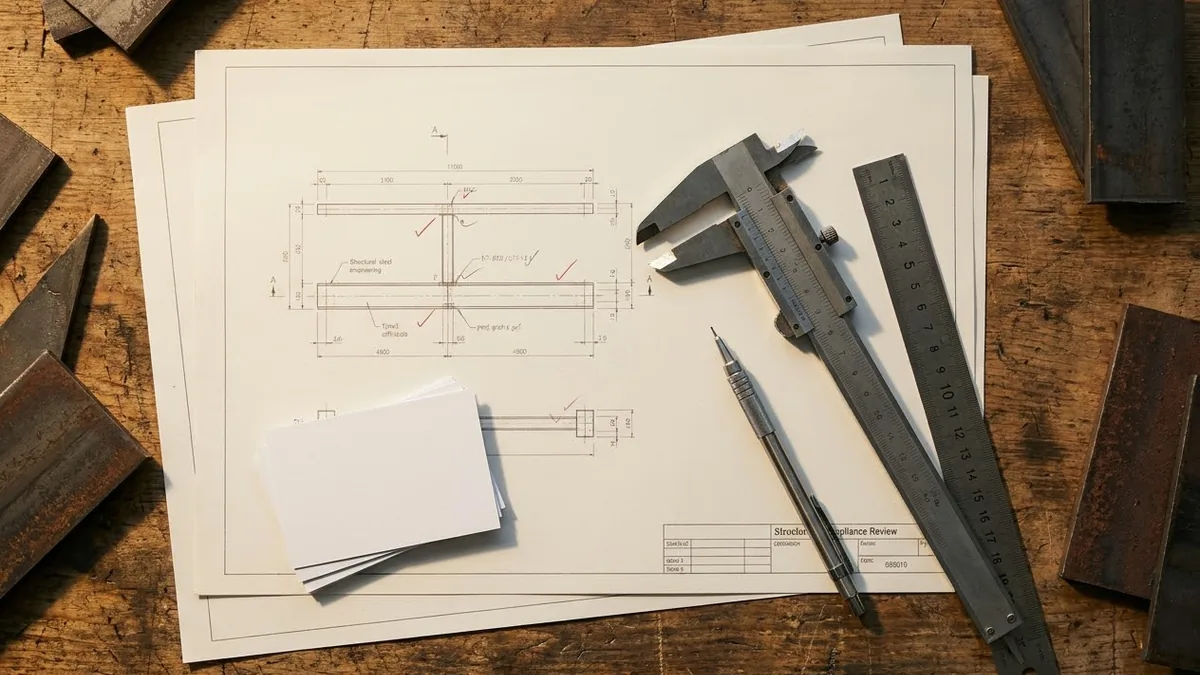
Weld Australia’s tick-and-flick compliance warning is a practical reminder for fabricators: quote records need enough evidence to show what was priced, assumed, excluded, and verified.
Defending Your Estimating Assumptions in Audits
[Updated: 2026-07-08] Weld Australia’s June 2026 warning about a “tick-and-flick” compliance culture should push fabrication estimators to record the basis of every serious quote more carefully. The estimator does not become the certifier, engineer, or lawyer. But the quote should show which drawings were used, which standards or project specifications were allowed for, what supplier and subcontractor evidence supports the price, and which compliance items remain assumptions or exclusions.
That matters because steel fabrication compliance is rarely proven by one late checklist. Structural steel quality depends on controlled inputs, welding procedures, material traceability, inspection points, construction category requirements, and clear handover documents. If the quote record cannot show those items were recognised before award, the shop may inherit compliance work it never priced.
Weld Australia Compliance Best Practices for Fabricators
On 2 June 2026, Australian Manufacturing reported Weld Australia’s warning that Australia has a broader “tick-and-flick” compliance problem. Estimators looking to secure their bidding practices should reference the new Weld Australia compliance quoting guidelines. This aligns with our detailed roadmap for AS NZS 5131 compliance structural steel modeling.
For a fabrication shop, that is not just a policy debate. It lands in tender packs, customer clauses, supplier certificates, inspection and test plans, welding requirements, and late requests for declarations. The estimating team is often the first group to see whether the job asks for proper evidence or only asks someone to tick a box after the fact.
A good quote record does not guarantee compliance. It does something more practical: it proves what the fabricator understood, priced, qualified, and asked about before taking the work. When a customer later asks why certification, testing, traceability, or inspection was excluded, the answer should be in the job file, not in someone’s memory.
Standards context
The Australian Steel Institute says AS/NZS 5131 gives the technical foundation for structural steelwork fabrication and erection, while the National Structural Steelwork Compliance Scheme supports checking, auditing, and certification. ASI also notes that welding is a special process where finished output cannot readily be checked without destroying the component, so the inputs must be controlled.
Weld Australia describes AS/NZS ISO 3834 as the quality requirements for fusion welding of metallic materials, covering production control whether work is fabricated on site or in a workshop. It states that the approach seeks to control the welding process from design through to inspection, because inspection after completion does not guarantee weld serviceability.
Those two points are important for estimators. If quality must be built into the process, the quote needs to make room for the process. The price may need to include procedure review, qualified welders, consumables control, inspection hold points, third-party audits, material certificates, coating documentation, or extra administration. If those are not included, the offer should say so plainly.
Quote records
A defensible quote record is not a pile of documents. It is a dated trail that connects the customer request to the price. The aim is simple: another competent person should be able to open the file later and see how the estimate was built and where compliance risk was treated.
Founder-style observation: the worst compliance risk is not always the missing certificate. It is the quiet assumption that someone else will sort it out after award, with no budget and no record of who agreed to it.
AS/NZS 5131
AS/NZS 5131 can affect the quote because it changes the work behind the work. Steelwork Compliance Australia says AS/NZS 5131 sets the quality benchmark Australia expects for safe structures and introduces the concept of construction category. It also notes that AS/NZS 5131 covers product conformity, while conformity assessment sits with the NSSCS.
For estimators, the construction category and project specification can drive the depth of documentation, inspection, welding control, traceability, and approval steps. A small architectural bracket and a major structural package should not carry the same compliance allowance. The quote should reflect the level of control the project actually requires.
Compliance plans
The ASI guidance for builders says implementing AS/NZS 5131 and the NSSCS includes configuring project documentation, providing required project documentation at the right time, and providing a declaration of compliance. ASI also recommends a Compliance Management Plan for all but the simplest projects.
ASI says a Compliance Management Plan should specify processes and documentation for the veracity and traceability of compliant structural steel, bolts, and consumables, assign responsibilities, and define inspections, testing, auditing, approvals, and governance. That list is useful even when the customer has not supplied a formal plan. It tells the estimator what questions to ask before pricing.
If the RFQ does not say who owns a requirement, do not bury it in the rate. Ask. If the answer does not arrive before submission, qualify the quote. This is how a shop avoids turning unclear compliance obligations into free work.
Review checklist
Use this check before submission on structural work, regulated work, imported steel packages, public projects, or jobs where the customer has named AS/NZS 5131, AS/NZS ISO 3834, NSSCS, SCA certification, special inspections, or declarations of compliance.
This is not legal, engineering, or certification advice. It is estimating discipline. A fabricator still needs competent technical review and contract advice for the project. The estimator’s job is to make sure the price does not pretend the risk is simpler than it is.
Kwantflow role
Kwantflow is built for the part of the job that happens before the quote goes out: bring RFQ files into one local-first workspace, review source documents, keep takeoff lines and assumptions together, and preserve the evidence behind the customer response. For compliance-heavy work, that matters because the record is often as important as the rate.
The practical workflow is to import the RFQ pack, review supported files, capture assumptions, record clarification questions, keep supplier evidence with the estimate, and have a person approve the final quote basis. AI can help summarise and organise the pack, but it should not accept compliance risk or decide the sell price. The estimator stays in charge.
Start tightening your RFQ workflow today. [Updated: 2026-07-07] Traceable compliance is also a major concern for sheet metal fabricators adopting cutting automations. See how automated nesting affects production standards by reading about the Lantek and Tecoi strategic sheet metal partnership.
Sources
Existing source link, retrieved 2026-07-14.
Existing source link, retrieved 2026-07-14.
Existing source link, retrieved 2026-07-14.
Method
This legacy article was reviewed as an ANZ editorial asset. Source-backed statements should be checked against the linked primary material, while product and workflow statements remain subject to estimator review. This article is not legal, engineering, certification, or customer-outcome evidence.
Ways estimators can keep quote review clear:
- Weld Australia’s warning is about verification, not paperwork volume. Estimators should treat every quote as the start of a compliance evidence trail.
- For structural steel, AS/NZS 5131, AS/NZS ISO 3834, construction categories, declarations of compliance, and project documentation can affect what must be priced and recorded.
- A defensible fabrication quote separates priced scope, exclusions, assumptions, supplier evidence, inspection requirements, welding quality requirements, and revision basis.
- Software helps when it keeps source files, takeoff lines, assumptions, quote versions, and approval notes together without taking control away from the estimator.