Tender Alternates and Provisional Sums: A Quote-Basis Checklist
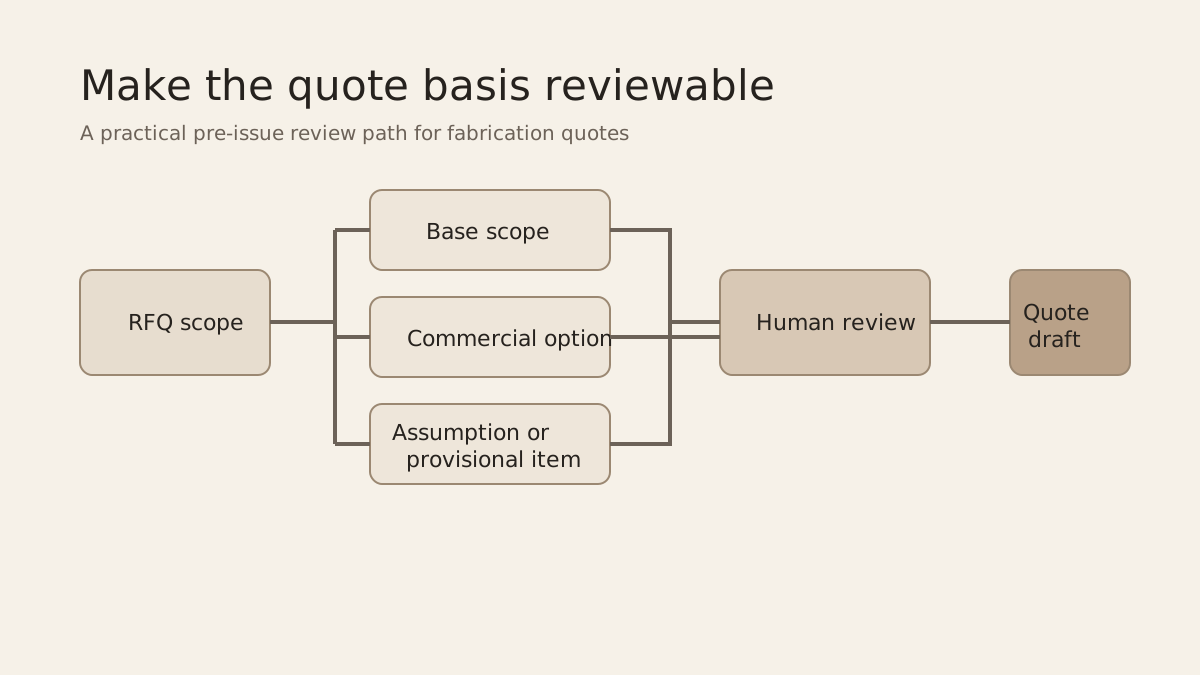
Keep base scope, commercial options, provisional allowances, exclusions, and revision basis visible before a tendering subcontractor issues a quote.
Start with the reviewed base scope
A quote becomes difficult to review when it compresses different kinds of uncertainty into one total. Before a tendering subcontractor issues a fixed-price fabrication offer, record the drawing revision, specifications, inclusions, exclusions, lead-time assumption, and the date supplier or rate inputs were checked.
The base offer should be understandable on its own. NSW construction procurement guidance says an alternative tender must describe and price each alternative on a separate tender schedule when alternatives are considered. That is a useful review discipline even where the exact procurement rules do not apply.
Keep alternatives separate from provisional allowances
An option is a deliberate commercial path, such as a different package or lead time. A provisional allowance is uncertainty identified at tender time. Queensland Government guidance describes a provisional sum as a mechanism in which the principal takes price risk for identified work or items, while provisional quantities may be used when the work cannot be accurately quantified at tender time.
For each provisional item, note the work or material covered, why the extent is uncertain, the basis of the allowance, what would trigger a change, and the review owner. NSW ICAC guidance distinguishes a provisional allowance flagged from the start from a variation that occurs unexpectedly during the project.
Describe the commercial path, not only the total
A reviewer should be able to answer a simple question without reconstructing the estimate: what changes if the customer chooses this option? Give each option a short name, state the scope difference, and show whether it changes inclusions, exclusions, lead time, quantities, materials, finish, installation, or pricing. A separately described option is easier to compare than a second total buried in a cover email.
This is particularly important when one option removes work that is otherwise included in the base offer. State what remains in the base scope and what moves to the option. If the customer needs a choice between packages, treat each package as a commercial path with a clear description rather than assuming the reader will infer the difference from price alone.
Do the same for a provisional item. Record the condition that is unknown at quote time, the information used to estimate it, the allowance amount or rate basis, and the event that causes the item to be reviewed. That record helps the estimator distinguish uncertainty identified before issue from a later scope change.
Keep a review record with the tender files
The five fields are most useful when they can be checked against the RFQ evidence. Keep the drawing or specification reference beside the affected assumption, option, or exclusion. Record who reviewed the item, when it was checked, and whether it must be confirmed before award. This does not make a tender risk-free; it makes the basis of the proposed price visible for a commercial review.
When supplier pricing, access conditions, design detail, or quantities remain incomplete, avoid disguising that uncertainty as a final fact. Escalate the question, use a clearly labelled allowance where the project documents support it, or state the exclusion. The right commercial treatment depends on the tender documents and contract form, so obtain appropriate commercial or legal advice where required.
The review record should also show how the allowance or option reached the customer-facing document. Link the commercial line back to the affected estimate item, note the source document and revision, and preserve the reviewer decision beside the issued version. If a later addendum resolves the uncertainty, replace the provisional basis through a controlled revision instead of silently editing the old output. That sequence gives the next reviewer a practical trail from RFQ evidence to estimate treatment, approval, and issued quote.
Before approval, compare the option and allowance against the base scope one final time. Check that quantities are not counted twice, that an exclusion has not removed work still priced elsewhere, and that the stated trigger is something the team can actually observe. These checks are simple, but they prevent a well-presented total from hiding an inconsistent commercial basis.
Kwantflow can retain the reviewed RFQ context, quote options, commercial notes, assumptions, exclusions, and revision history in the same workspace. That gives an estimator and approver a shared place to inspect the basis before output is issued, while leaving the commercial judgement with the team.
Make exclusions and revisions visible
Before issue, confirm that exclusions do not conflict with the base scope and that every alternative has its own price and description. When a new addendum arrives, preserve the previous commercial snapshot, identify the affected estimate items, and make the new revision basis explicit.
Kwantflow is a quote-preparation workspace, not a legal or tender-evaluation system. It helps teams keep reviewed estimate context and commercial information together while the estimator remains responsible for the final customer-facing decision.
Use a five-field pre-issue check
| Field | Reviewer question | --- | --- | Base scope | Which reviewed assets and revision documents are included? | Option | Is each commercial alternative separately named, described, and priced? | Provisional item | What is uncertain, what allowance has been used, and what changes it? | Exclusions | Can a reviewer see what the total does not cover? | Revision basis | What changed since the last issued output and who checked it? |
|---|
Kwantflow can support that review by keeping commercial details and issued revisions close to the reviewed RFQ context. It does not turn this checklist into legal advice or remove the need for estimator approval.
Where Kwantflow fits
In Kwantflow, prepare customer-facing quote output from reviewed estimate work, then review commercial options, markups, lead time, notes, terms, assumptions, and exclusions before export. Quote revisions preserve a record of issued output, so a later addendum can be reviewed against the earlier commercial snapshot.
For adjacent workflow guidance, see how to handle quote revisions without losing the original scope and how to keep estimating assumptions visible before quote review.
Sources
Queensland Government: Fundamental Concepts and Principles of Queensland Government Standard Building Construction Contracts, retrieved 2026-07-15.
NSW ICAC: Managing contracts when cost estimates are uncertain, retrieved 2026-07-15.
NSW Government: Construction practice guide, preparing project management services tender documents, retrieved 2026-07-15.
Kwantflow: Prepare a quote and Quote options and revisions, retrieved 2026-07-15.
Method
This article uses selected Queensland and NSW public procurement guidance for process education. It does not claim that every fabrication tender is governed by those rules, provide legal advice, or make customer, performance, compliance, or outcome claims.
Ways estimators can keep quote review clear:
- Keep the reviewed base scope separate from any alternative commercial path before comparing totals.
- Record provisional allowances with their uncertainty, basis, and trigger instead of hiding them inside one price.
- Make exclusions and the drawing or addendum basis visible on every issued revision.
- Use commercial software to organise reviewed context, while retaining estimator approval of the final output.