Price escalation clauses and quote validity for steel fabricators under 2026 tariffs

2026 steel tariffs are forcing fabrication estimators to rethink price escalation clauses, supplier quote validity windows, and material cost tracking. Practical guidance written for estimators, not lawyers.
Quick answer: what changes for estimators under the 2026 steel tariffs?
The 2026 steel tariff regime — including the 50 per cent Section 232 tariff on imported steel in the United States, Australia’s ASI Safeguard inquiry into fabricated structural steel imports, and Canada’s counter-tariffs on US steel — has changed fabrication quoting in three practical ways.
First, supplier quote validity windows have collapsed. A year ago, a steel supplier quote was good for 30 to 45 days. Today, many suppliers will hold a price for 7 to 14 days at most, and some refuse to quote more than a few days ahead of order placement. This means a fabrication estimator can no longer collect supplier quotes at the start of a tender window and assume those prices will hold through bid submission and PO placement.
Second, the base cost of steel has become unpredictable week to week. US construction input prices rose at a 12.6 per cent annualised rate in early 2026, driven directly by the Section 232 tariff expansion in April. Australian fabricators face a different but equally disruptive dynamic: cheap imported fabricated steel from China has surged by more than 50 per cent, with the ABC News reporting steel businesses closing as a result. The Productivity Commission is now holding a safeguard inquiry that could itself shift pricing before any decision is announced.
Third, the estimator’s quote file now needs to carry more than just a price. It needs to document the material cost basis, the supplier quote used, the validity date, the assumed tariff regime, and any price escalation mechanism offered to the customer. Without this documentation, the shop has no way to defend its pricing when a customer asks why costs moved between quote and order.
<strong>Disclaimer:</strong> This article provides practical workflow guidance for fabrication estimators. It is not legal advice. Price escalation clauses are contractual instruments that should be reviewed by a qualified legal professional before use in live contracts. The templates and suggestions here are starting points for estimator discussion, not enforceable contract language.
Why supplier quote validity windows have shrunk to 7–14 days
Supplier quote validity windows are the number of days a steel supplier guarantees a quoted price. In stable markets, this window protects both supplier and buyer: the supplier knows they can source steel at stable mill pricing, and the buyer knows they can plan a quote around a known material cost. When prices are volatile, that guarantee becomes too expensive for suppliers to offer.
The 50 per cent Section 232 tariff on US steel imports, effective April 6 2026, changed the market overnight. Quotr reports that nonresidential construction input prices hit a 12.6 per cent annualised rate, the fastest since 2022. The Bricks & Bytes analysis notes that iron and steel posted monthly jumps large enough to wreck quarterly forecasts. Steel suppliers who previously offered 45-day pricing now face mill price increases that can erase their margin within a week.
For the estimator, the practical impact is that the old quoting rhythm no longer works. A typical workflow was: collect supplier prices in week one, build the quote in week two, review and submit in week three, wait for PO in weeks four to eight. That rhythm assumed the week-one supplier price would still be valid when the PO arrived. Under the current volatility, an estimator who collects supplier prices at the start of a tender and submits the quote two weeks later is pricing from numbers that may already have expired.
The table below shows how validity windows have changed across different market conditions. These are not fixed rules — they are reference ranges based on current market observations.
| Market condition | Typical validity (2024–2025) | Typical validity (2026) | Estimator action |
|---|---|---|---|
| Stable market | 30–45 days | 21–30 days | Standard process with monthly price check |
| Moderate volatility | 21–30 days | 14–21 days | Date-stamp every supplier quote, set internal alerts |
| High volatility / tariff disruption | 14–21 days | 7–14 days | Request re-quote before submission, include escalation clause |
| Crisis conditions (current US Section 232) | 7–14 days | 3–7 days | Real-time price check at bid deadline, escalation clause mandatory |
The most important habit shift is simple: date every supplier quote, record the stated validity date, and set a reminder or internal process that flags quotes approaching expiry. If a quote expires before the tender is accepted, the estimator should either request a fresh quote or include a price escalation clause that covers the gap.
What a price escalation clause looks like in a fabrication quote
A price escalation clause is a contractual provision that allows the quoted price to be adjusted if material costs change between quote acceptance and order placement or fabrication. For fabrication estimators, the goal is not to write the legal clause — that is a lawyer’s job — but to understand the options so you can discuss them with customers and document the commercial intent in the quote file.
There are three common price escalation structures relevant to steel fabrication quoting:
| Structure | How it works | Best suited to | Risk to estimator | Risk to customer |
|---|---|---|---|---|
| Fixed price | Price is locked for a stated validity period. No adjustment after acceptance. | Short fabrication runs, stable material supply, trusted supplier pricing | High — absorbs all post-quote cost movement | None — knows exact cost at acceptance |
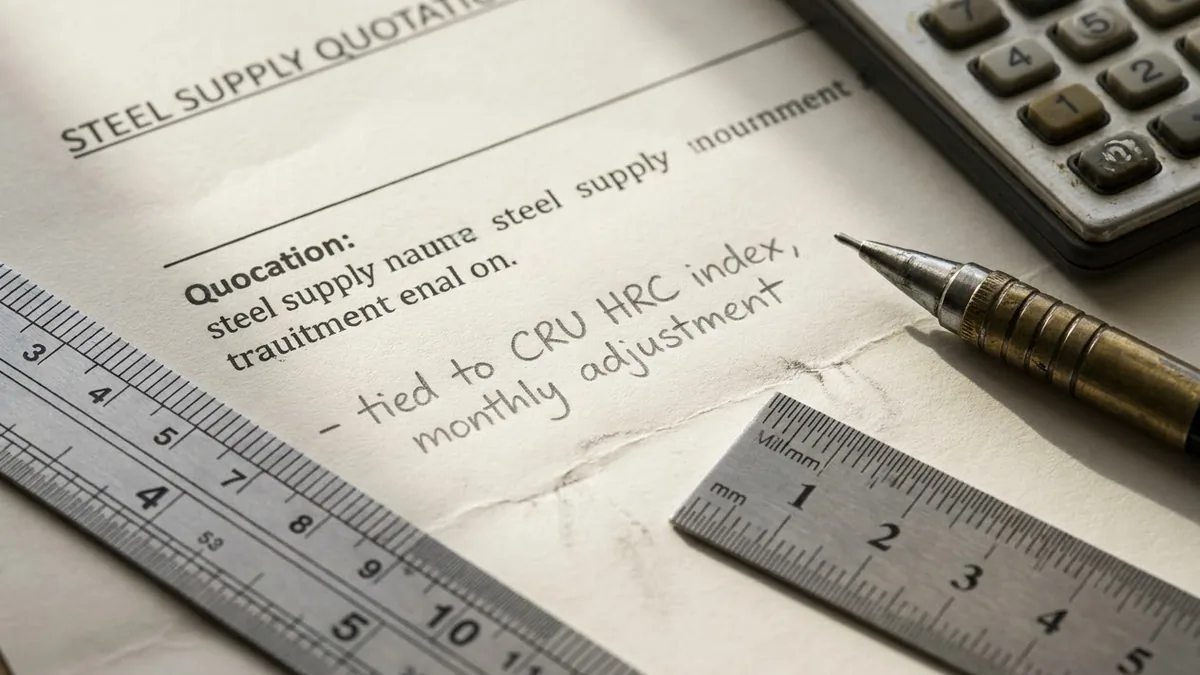
| Index-linked escalation | Price adjusts based on a published steel price index, typically CRU HRC or Platts TSI, using a stated base date and adjustment formula | Longer contracts, structural packages with multi-month lead times, volatile markets | Low — cost movement passes through | Moderate — accepts index movement risk |
| Pass-through (direct cost) | Material cost passes directly to customer at actual cost, with no margin buffer applied to the material. Fabrication labour and overhead are quoted separately | Projects where material represents large cost share and customer accepts transparency | Very low — no material risk | High — bears full material volatility |
Index-linked escalation is the most common approach in steel fabrication. The US Department of Defense uses a similar mechanism for nonstandard steel items in its FAR clauses, tying price adjustment to a base steel index and a current steel index. For fabrication shops, the principle is the same: the quote states a base material price per tonne, references a published index, and defines adjustment intervals (monthly or quarterly) and a cap (usually 10–15 per cent total adjustment).

<strong>A practical escalation clause template for estimator discussion:</strong>
<blockquote>Material price is quoted based on [supplier name] pricing dated [date] with validity through [date]. If steel prices increase by more than [X] per cent during the quotation validity period, as measured by [CRU HRC index OR Platts TSI OR supplier published price list], Kwantflow reserves the right to adjust the material cost component by the documented index movement. Any such adjustment will be supported by published index data and communicated to the customer before order placement. Customer agrees that material cost risk beyond the stated validity date will be shared through this escalation mechanism.</blockquote>
Have a lawyer review any clause before using it in a live contract. The purpose of drafting it at the estimating stage is to clarify the commercial intent, not to create a legally binding instrument.
Which steel price index to reference for escalation
Not all steel price indexes apply to fabrication. The estimator needs an index that reflects the material actually being purchased, not a headline number a commodity analyst tracks.
| Index | What it measures | Relevance to fabrication |
|---|---|---|
| CRU US Midwest HRC | Transaction price for US domestic HRC steel, assessed since 1980 | Best for US structural steel, widely referenced in US steel supply contracts |
| Platts TSI | HRC, plate, rebar, and scrap assessments across US, Europe, and Asia | Useful for multi-region procurement or when the supplier uses Platts pricing (S&P Global) |
| MetalMiner monthly index | Composite of US carbon steel prices across products | Practical for smaller shops without direct access to CRU/Platts subscriptions |
| ABS structural steel PPI | Australian PPI for structural steel products | Relevant for Australian fabricators quoting to domestic mills, published quarterly |
| Supplier published price list | The supplier’s own list price and any published increases | Most practical for day-to-day quoting, reflects actual price the shop will pay |
For most fabrication work, the combination of the supplier’s published price list and a published index provides the best balance. The supplier price list drives the actual cost basis. The published index provides an independent reference that both the estimator and the customer can verify.
How to document material cost basis in every quote
Documenting the material cost basis does not need to be slow or bureaucratic. A practical template that fits within the estimating workflow prevents disputes later.
<strong>Every quote file should record these material cost items:</strong>
- The date the material price was obtained from each supplier
- The supplier name and quote reference number
- The stated validity date of each supplier quote
- The material grade, section sizes, and quantities covered by the supplier price
- The delivered price per tonne including transport
- Whether the price assumes any tariff or safeguard regime (current Section 232, ASI Safeguard, or none)
- Which index would apply if an escalation clause is offered
When sharing this information with the customer, keep it practical. A short note at the bottom of the quote is usually enough:

The documentation serves two purposes. First, it protects the shop if material prices rise before the purchase order arrives. Second, it gives the customer confidence that the quoted price is built on verified supplier pricing, not on a guess.
Regional notes: US, Australia, and Canada tariff variations
The 2026 tariff situation is not uniform. Estimators need to understand how their region’s specific tariff regime affects quoting, because a price escalation clause that works for a US shop may not fit an Australian or Canadian customer.
<strong>United States:</strong> The Section 232 steel tariff was raised to 50 per cent on April 6 2026, covering steel articles made entirely or almost entirely of steel. A 25 per cent derivative tariff applies to the full value of products substantially made of steel. The Supreme Court’s November 2025 ruling that IEEPA tariffs require Congressional authorisation has narrowed the legal channel to Section 232, making the current rate more durable than emergency tariffs. US estimators should assume 50 per cent on imported steel is the baseline.
<strong>Australia:</strong> Australia faces a different supply dynamic. Fabricated steel imports have surged by more than 50 per cent from China, with steel businesses closing. The Productivity Commission is now holding a safeguard inquiry on whether measures, potentially a 50 per cent tariff rate quota, should apply to imported fabricated structural steel. Australian estimators have two uncertainties: whether safeguard measures will be approved, and what Chinese suppliers will do to pricing in the meantime. Domestic mill and imported pricing are diverging, and the quote should specify which supply source the price assumes.
<strong>Canada:</strong> Canadian fabricators face 50 per cent Section 232 tariffs on steel exports to the US, plus Canada’s own 25 per cent counter-tariffs on US steel. The derivative tariff (25 per cent of full product value) hits Canadian manufacturers hard because many ship fabricated products rather than raw steel. For cross-border projects, clarify in the quote whether the US buyer or the Canadian fabricator bears the tariff cost.
What quoting software can do (and not do) for price risk
No quoting software replaces estimator judgement. But the right software makes it easier to see the material cost basis, track validity dates, and document assumptions. A shop that relies on memory or paper files will miss a supplier price expiry on a busy tender week.
Kwantflow helps in three ways. First, it keeps supplier quotes, takeoff data, pricing assumptions, and customer-facing conditions in one file rather than across a spreadsheet, emails, and paper notes. When a supplier quote expires, the estimator can see it alongside the drawing set and pricing lines.
Second, because Kwantflow runs locally on the estimator’s machine rather than in the cloud, sensitive supplier pricing stays on the shop’s hardware. In a volatile market where pricing intelligence is a competitive advantage, a desktop quoting platform keeps that intelligence where it belongs.
Third, the local-first architecture means the estimator can open a previous quote, review the material cost basis, and carry forward or update the pricing without re-entering data. For shops quoting similar packages repeatedly, this reduces the risk of missing a material cost change between bids.
Competitive tendering strategies for steel fabricators covers the same volatility problem from a tender review angle, including how to handle supplier quote validity as part of bid strategy.
Job shop quoting workflow: pricing risk under 2026 steel tariffs is the updated companion article covering the full six-stage quoting workflow with tariff-specific sections added for price escalation and validity management.
Pricing risk in quotes without hiding it covers the broader framework for contingencies, provisional items, and exclusions. Escalation clauses are one tool within that framework.
Estimating material costs for structural steel fabrication is the companion guide for building the material cost baseline that a price escalation clause would reference.
When there is no escalation clause: handling post-quote price moves
The hardest situation is the one where the estimator did not include an escalation clause and steel prices move before the purchase order arrives. This happens for three reasons: the customer refused an escalation clause, the estimator did not expect prices to move during the tender window, or the tender was so competitive that adding escalation language felt like a risk.
When the price move is small (under 5 per cent), most shops absorb it as a cost of doing business. The estimate had a contingency buffer that covers the gap, or the shop accepts thinner margin to keep the customer relationship intact.
When the price move is large (10 per cent or more), the estimator needs a direct conversation with the customer. Show the supplier quote that was used to build the price, the current supplier price, and ask the customer to share the increase. Some will agree. Some will hold the original price. In both cases, the documentation of the original material cost basis is the evidence that supports the shop’s position.
Founder-style observation: the shops that handle price moves best are the ones that talk about material cost transparency before there is a problem. If the customer understands from the first conversation that the quote is built on a documented supplier price with a known validity window, the post-PO conversation about increases becomes a discussion of shared data, not a negotiation of who was unfair.
FAQ
Ways estimators can keep quote review clear:
- Supplier quote validity windows have collapsed from 30–45 days to 7–14 days under 2026 tariff volatility, forcing estimators to date-stamp every pricing assumption.
- A price escalation clause ties material cost adjustments to a published index such as CRU HRC or Platts TSI, transferring post-quote price risk from the fabricator to the buyer.
- Fixed-price, index-linked, and pass-through structures each suit different project types and customer relationships. No one approach works for every job.
- Kwantflow helps estimators document material cost basis, track supplier quote expiry dates, and keep pricing assumptions visible through every quote revision.
