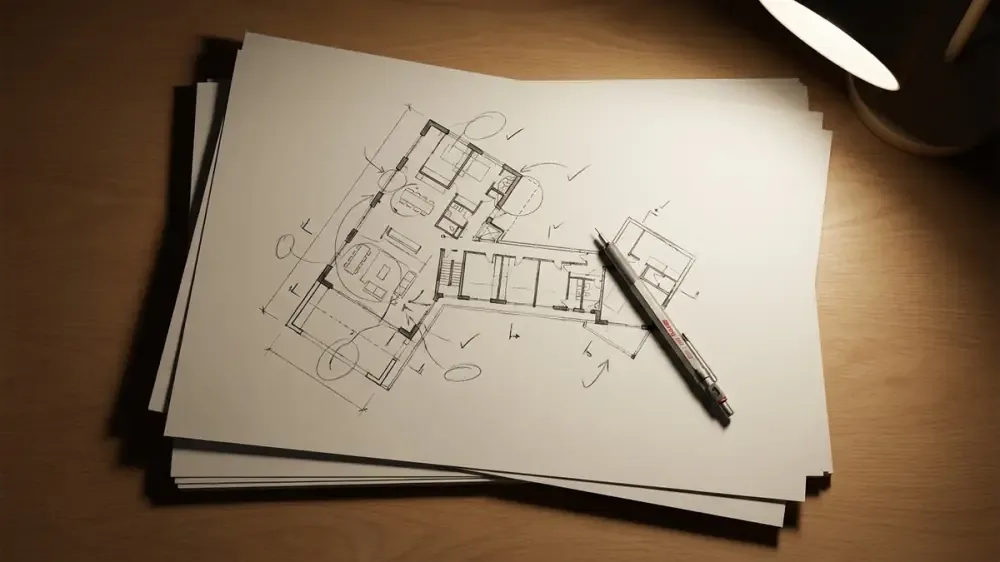
AI can speed up draft estimating, but it should never become a black-box replacement for estimator judgement, evidence review, and quote accountability. Evidence, confidence, human review, source traceability, and clear data boundaries all need to stay in the workflow.
Limits of automation
AI should not replace estimators. It should assist with draft extraction, file triage, revision flagging, clarification prompts, and evidence grouping while the estimator remains responsible for source verification, scope interpretation, commercial judgement, assumptions, exclusions, pricing, and final quote approval. If an AI-generated line cannot be traced to source evidence and accepted by a human, it should stay out of the quote.
VC hype vs operator reality: The June 2026 stealth exit of startups like Uptool ($6M Seed) and Korso entering YC 2026 highlights the massive hype around fully automated cloud-based quoting. However, operators are pushing back against these black-box systems that consistently miss custom hardware, ignore actual shop rates, and expose IP.
The safe model is AI-assisted estimating, not unattended estimating. Software can make the first draft faster, but the business still owns the customer commitment. In a local-first product, that also means AI drafts should keep file evidence, issue flags, confidence, and approval state close to the estimate instead of hiding them behind a black box. For related workflow boundaries, see what to automate in RFQs for metal fabricators and RFQ processing software before pricing.
Fidelity over speed
AI can accelerate the early stages of estimating: grouping RFQ files, extracting drawing numbers, flagging missing revisions, and drafting a first-pass takeoff. Those are genuinely useful tasks where speed helps without introducing commercial risk.
The problem starts when draft outputs are treated as final without evidence. A line item that appears in an AI-generated estimate should point back to the source document so the estimator can verify the quantity, unit, and rate assumption. Without that chain, the estimate becomes a guess that happens to be fast.
Shops are increasingly redesigning their machining RFQ workflows using historical data to ground their estimates in physical shop runs. This shift highlights why estimators push back on black box quotes that lack verifiable geometry verification.
Kwantflow’s current app contract follows the same principle. Kwantflow AI can use text, PDF, image, and CAD-derived evidence after local preprocessing, but the quote engine still owns totals, rollups, markup, and commercial math. Unsupported, unreadable, or weak files should show up as issues rather than disappearing from the draft.
Official guidance from NIST and the OAIC warns that generative AI outputs can be inaccurate, biased, or fabricated. For estimating teams, that means no AI-generated line item should reach a customer quote unless a human has confirmed the source evidence.
Triage confidence metrics
Some AI estimating tools surface confidence scores for each extracted quantity or suggested rate. A confidence score tells the estimator how certain the model is, not how accurate the output is. A high-confidence mistake is still a mistake.
Confidence scores are most useful for triage: low-confidence items need immediate human review, medium-confidence items benefit from spot-checking, and high-confidence items still need a sanity check against the source document. The estimator remains accountable for the final number regardless of the score.
Understanding model errors
Hallucinations in estimating usually fall into three categories. The first is invented quantities: the model guesses a dimension or count that does not appear in any source document. The second is incorrect units: pricing structural steel in metres instead of tonnes, or sheet metal in pieces instead of square metres. The third is phantom scope: including work that the source drawing does not describe.
These errors are hard to catch if the reviewer assumes the draft is mostly correct. The safest workflow is to treat every AI-generated line as a draft that must be confirmed against source documents before being included in the quote. NIST and DTA guidance both stress verification, provenance tracking, and human oversight for any AI-influenced decision.
Keeping human control
Estimator human review catches what AI cannot: context, contract knowledge, customer-specific commercial judgement, and awareness of scope boundaries that are implied rather than written. A model cannot know whether a particular client always expects galvanising to be included, or whether a long-standing supplier credit covers a new scope element.
The practical workflow is AI-assisted drafting followed by estimator-led review, evidence checking, commercial adjustment, and final approval. This is consistent with ACSC guidance on AI data security and provenance: automated outputs must be traceable to trusted sources, and a human must remain accountable for the final commercial decision.
Local vs hosted AI
Kwantflow AI runs on the device and processes estimating evidence without sending RFQ files to an external model provider. That is the strongest default for sensitive tender packages, customer drawings, proprietary rates, and margin information. It also keeps the estimating workflow aligned with local-first control: the estimator can keep working without handing the whole quote basis to a browser service.
The important limitation is file fidelity, not just model location. In Kwantflow’s current app contract, Kwantflow AI uses prepared evidence: PDFs become text and bounded page images, images are normalised, office files such as CSV, DOCX, and XLSX become structured text, and CAD files become rendered views plus metadata where possible. It does not mean the model natively understands raw STEP, IGES, OBJ, STL, 3MF, DXF, DWG, IFC, DOCX, or XLSX semantics.
Hosted AI can be useful in some products, but it changes the data boundary because files or prepared evidence may be sent to a third-party provider. Kwantflow’s visible AI product path is currently Kwantflow AI only; cloud/provider controls and model switching are not exposed in the desktop UI. For estimating teams assessing any hosted tool, OAIC guidance still applies: do not upload sensitive customer or commercial information without an approved data boundary, retention position, and review process.
Local-first estimating software offers better offline control. For format-level limits, see supported file handling in estimating software.
Verifying quote sources
Source traceability means every quantity, rate, and assumption in the estimate can be traced back to the source file that produced it. If an AI draft says 12.4 tonnes of structural steel, the estimator should be able to see which drawing and which bar list produced that number.
This is not just an AI concern. The same principle applies to manual estimating: traceable estimates are easier to review, easier to revise when drawings change, and easier to defend if the customer questions a line item. For AI-assisted workflows, traceability becomes even more important because the model cannot explain its reasoning the way a human can.
Security boundary principles
This matrix keeps AI in the assist lane. It lets the tool reduce admin and draft work while making sure every commercially meaningful output is checked before it affects a quote.
Verification review checklists
Before an AI-generated item enters the estimate, the reviewer should be able to answer five questions: where did the item come from, what file and page support it, what unit is being used, what confidence or issue flag applies, and who approved it. If any answer is missing, the item should remain a draft.
Use a simple status path: draft, reviewed, accepted, rejected, or needs clarification. Draft means the AI created or suggested it. Reviewed means a human opened the source. Accepted means it can affect the estimate. Rejected means it is wrong or irrelevant. Needs clarification means the source is insufficient and a customer or supplier answer is required.
This workflow works for Kwantflow AI and other AI delivery models. The point is not which model generated the item. The point is whether the estimate can prove its basis before the quote is sent.
Assisted estimating framework
The practical takeaway is simple: treat AI as a drafting assistant, not an authority. If a line item cannot be traced and reviewed, it should not enter the quote.
Further reading
These sources support the same operating rule: use AI to accelerate review and drafting, but keep evidence, human judgement, and accountability in the quote workflow.
Empower your team. See how Kwantflow assists estimators with secure, local-first workflow tools.
Ways estimators can keep quote review clear:
- AI can help with draft estimating, file triage, and extraction, but it cannot replace estimator judgement, contract knowledge, or customer-specific commercial decisions.
- Every AI-generated estimate line should point back to the source document so reviewers can verify quantity, unit, and rate assumptions.
- Hallucination risk means AI can create plausible-sounding but incorrect takeoff items, units, or exclusions. Human review is the only reliable control.
- Kwantflow AI keeps data on-device and avoids third-party exposure. In Kwantflow, the visible AI product path is currently Kwantflow AI only, with hosted AI controls dormant unless a future product decision reactivates them.